Technology
Spanish-language models and the case of Mexico: ALIA, Latam-GPT and Coatlicue
Spain has already published a public Spanish-language model under an open licence. Latin America has its own, built on a Meta model. Mexico has a plan, a supercomputer on the way and one published model, fine-tuned on a French one. The constraint that decides everything is a different one: megawatts.
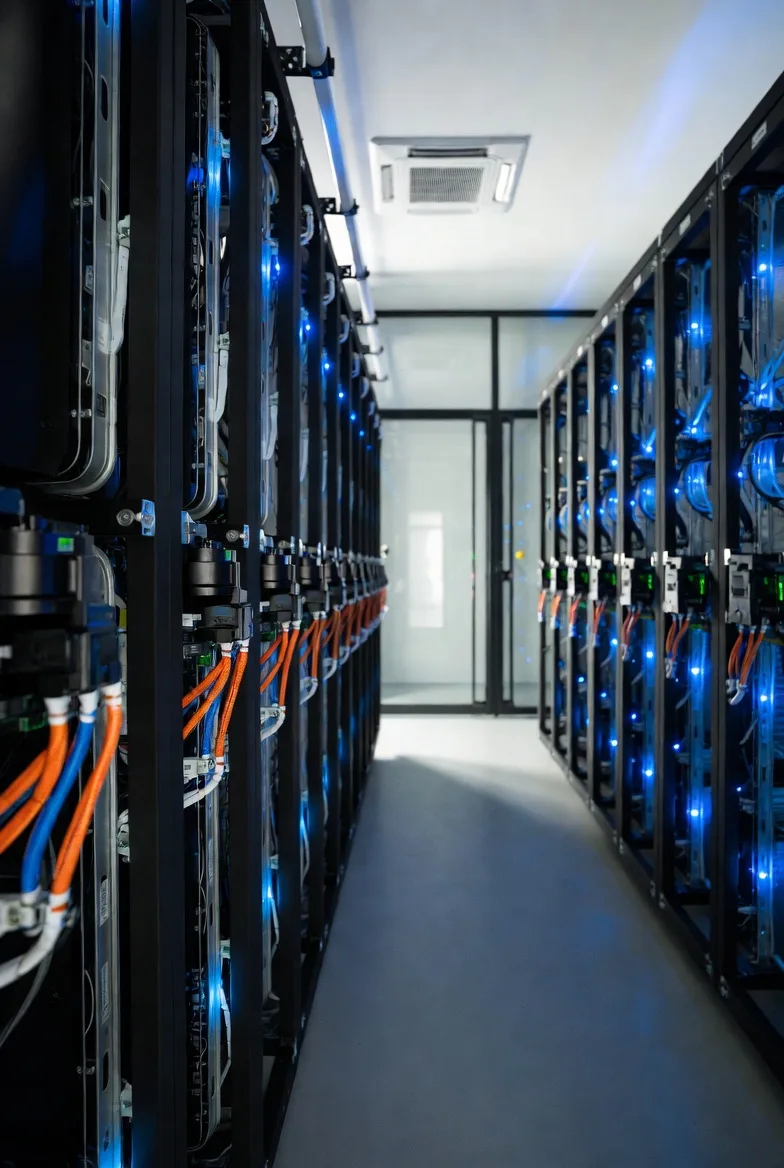
Generation, storage and interconnection for compute and industrial loads in the Bajío.
Let's discuss your projectBajío Ventures · October 2026 · Sovereign AI, 5 of 5
The four previous posts reviewed the producers of models: Germany, France, the United States and China. This one reviews those who need models in Spanish. There are three different answers available, and Mexico has not chosen one yet.
Spain: the public model with an open licence
ALIA is the model family of the Barcelona Supercomputing Center, funded by Spain’s Ministry for Digital Transformation with NextGenerationEU funds.
| Feature | ALIA-40b |
|---|---|
| Parameters | 40.4 billion |
| Licence | Apache 2.0 |
| Languages | Spanish, Catalan, Basque, Galician and English as the core; 35 European languages in the base model |
| Training | MareNostrum 5 supercomputer |
| Instruction-tuned version | Published in December 2025; the current version is 2606 |
It is the cleanest option for a Spanish-speaking company or government: a public model, trained on public infrastructure, with an unrestricted licence. Its limit is its origin. Its focus is the languages of Spain; it was not designed for Mexican Spanish or for Mexico’s 68 national languages.
Latin America: the regional model on someone else’s base
Latam-GPT was presented in Santiago on 10 February 2026. Chile’s National Center for Artificial Intelligence (CENIA) coordinates it.
| Feature | Latam-GPT 1.0 |
|---|---|
| Parameters | 70.6 billion, the same architecture as its base |
| Base model | Meta Llama 3.1 with 70 billion parameters |
| Regional corpus | About 297 billion tokens |
| Licence | Llama 3.1 Community License |
| Participants | More than 75 institutions; data from 20 countries, Mexico included, according to its model card |
| Budget | USD 550,000, with support from CAF |
| Compute | AWS |
Read it plainly. The regional model is a Meta model, under a Meta licence, fine-tuned on Amazon’s cloud. What is sovereign is the corpus: the Latin American data gathered under licence. That has value, and for USD 550,000 it is an efficient investment. But whoever deploys it inherits the terms of a vendor that has already stopped publishing open frontier models.
Mexico: a plan and a machine, still no foundation model
Coatlicue. The federal government presented the public supercomputer on 26 November 2025: 14,480 GPUs, 314 petaflops, about MXN 6 billion and 24 months of development. In June 2026 its technical committee was set up and the site was confirmed at the IPN Unidad Zacatenco, with the start of works announced for August 2026 and two years of construction. The Barcelona Supercomputing Center advises the project. Nvidia takes part in the co-design and will supply the GPUs; completion is planned for January 2028. As of 25 September 2026, the Digital Transformation Agency placed the project at Cinvestav facilities in Zacatenco, at the stage of soil studies and permitting, with joint work with CFE and CENACE on the power supply.
Plan Nacional de IA (National AI Plan). The Digital Transformation and Telecommunications Agency (ATDT) published a plan with three pillars: ethical and legal framework, talent and public software, and strategic infrastructure. It includes Coatlicue, a “Fábrica de IA” (AI Factory) for government projects, and government data centers in Aguascalientes and Tulancingo. Coverage of the plan does not mention a national language model.
Models. In November 2025 KAL, from the Mexican company Saptiva, was presented to the Economy Minister as the country’s first generative model. Its Hugging Face model card describes it: a fine-tune of Mistral Small 3.2, a 24-billion-parameter-class model, an Apache 2.0 licence and published weights. It is a case of adopt and fine-tune, and the base is French. We did not find a Mexican foundation model.
Law. At the end of July 2026 there was no general AI law: the Senate committee closed the session without taking it to the floor, and the proposal first requires amending Articles 3 and 73 of the Constitution.
Indigenous languages. This is the real limit of any imported model. A UNAM researcher quantified it with Wikipedia: 4,272 articles in Classical Nahuatl, 1,201 in Yucatec Maya, 12 in Purépecha. Without data there is no model, and no one outside Mexico is going to gather that data.
The constraint that decides: megawatts
Sovereign compute is, first of all, an electrical load.
| Indicator | Figure | Source |
|---|---|---|
| Installed data center capacity in Mexico | 279 MW | MEXDC, via DCD |
| Under construction | 205 MW | Same |
| Projects in the CFE–MEXDC work plan | 1,705 MW | Same |
| Querétaro’s share of installed capacity | 72% | MEXDC, via Xataka |
| Cap of the self-supply (autoconsumo) scheme per facility | 20 MW | Expansión |
| Demand of an AI data center | 50 to 100 MW | Same |
A former chair of the Energy Regulatory Commission (CRE) states that there are data centers in Querétaro that have waited up to two years to connect. The governor replies that the problem is transmission and distribution, not generation. The two statements are compatible, and they are the same diagnosis we made for industry: the bottleneck is the grid.
The president set the political position on 18 August 2026: “Yes, we have to have data centers to advance in artificial intelligence, but Mexico does not necessarily have to be the data center for other parts of the world”. Growth, she said, must respond to national planning.
How much power does Coatlicue require? No official source publishes its demand. Using the ratio of Mistral’s data center in France (44 MW for 13,800 chips), a machine with 14,480 GPUs would be in the order of 46 MW. It is our own estimate, not an official figure, and it depends on the chip generation that is installed. It gives a sense of scale: it is more than double the self-supply cap and close to one sixth of the country’s entire installed capacity.
The Bajío is already part of this build-out. Guanajuato reports USD 630 million in three data centers, two of them operating in San Miguel de Allende and Apaseo el Grande, with a new 60 MVA substation.
Three routes for Mexico, from lowest to highest cost
- Adopt and fine-tune. Take a model with an Apache 2.0 licence, such as ALIA, Gemma 4 or Mistral Small, and fine-tune it with Mexican data. KAL already did this from the private sector. It is the route that fits within Coatlicue and within a public budget. The Aleph Alpha case shows that the value is in deployment.
- Build the corpus. Data in Mexican Spanish and in indigenous languages is the only asset that no one else can contribute. Latam-GPT showed that gathering it costs hundreds of thousands of dollars, not billions.
- Train from scratch. Mistral shows the scale: billions of euros and hundreds of megawatts. It is not a route for this decade without partners.
In all three, the precondition is the same: firm power and an interconnection point with capacity. For anyone investing in infrastructure in the Bajío, sovereign AI is not a software topic. It is a new, concentrated load with a schedule, and it must be planned the way a plant is planned.
In this series: Guide: what sovereign AI is · 1. Aleph Alpha · 2. Mistral · 3. United States · 4. China · 5. Spanish-language models and Mexico
Sources: Hugging Face, ALIA-40b-instruct-2606 · MuyComputerPRO, instruction-tuned ALIA 40B, Dec 2025 · AI Business, Latam-GPT, Feb 2026 · Hugging Face, Latam-GPT 1.0 · SECIHTI, Coatlicue, Nov 2025 · La Jornada, site and start of works, Jun 2026 · Expansión, Nvidia and Coatlicue, Sep 2026 · ConsumoTIC, Plan Nacional de IA, Sep 2026 · El Heraldo de México, Coatlicue site, Sep 2026 · El Financiero, KAL, Nov 2025 · IT Masters Mag, KAL · Hugging Face, KAL-24B-mx-v1 · Cadena Política, AI regulation, Jul 2026 · La Jornada, indigenous languages and AI, Mar 2026 · DCD, CFE and MEXDC, Sep 2026 · Xataka México, interconnection wait in Querétaro, Sep 2026 · Expansión, data centers and the power grid, May 2026 · Infobae, the president’s position, Aug 2026 · Mission Open Data, Mistral data center · Mexico News Daily, data centers in Guanajuato, Sep 2026
Bajío Ventures — a Mexican energy-infrastructure investment group based in Guanajuato: capital, a data platform on the region’s industrial base, and a German industrial channel, with its own advisory presence in Berlin.
Generation, storage and interconnection for compute and industrial loads in the Bajío.
Let's discuss your projectThis article is also available in Spanish. Read in Spanish