Market
The San Jerónimo hub, Chihuahua: on the border, still in planning
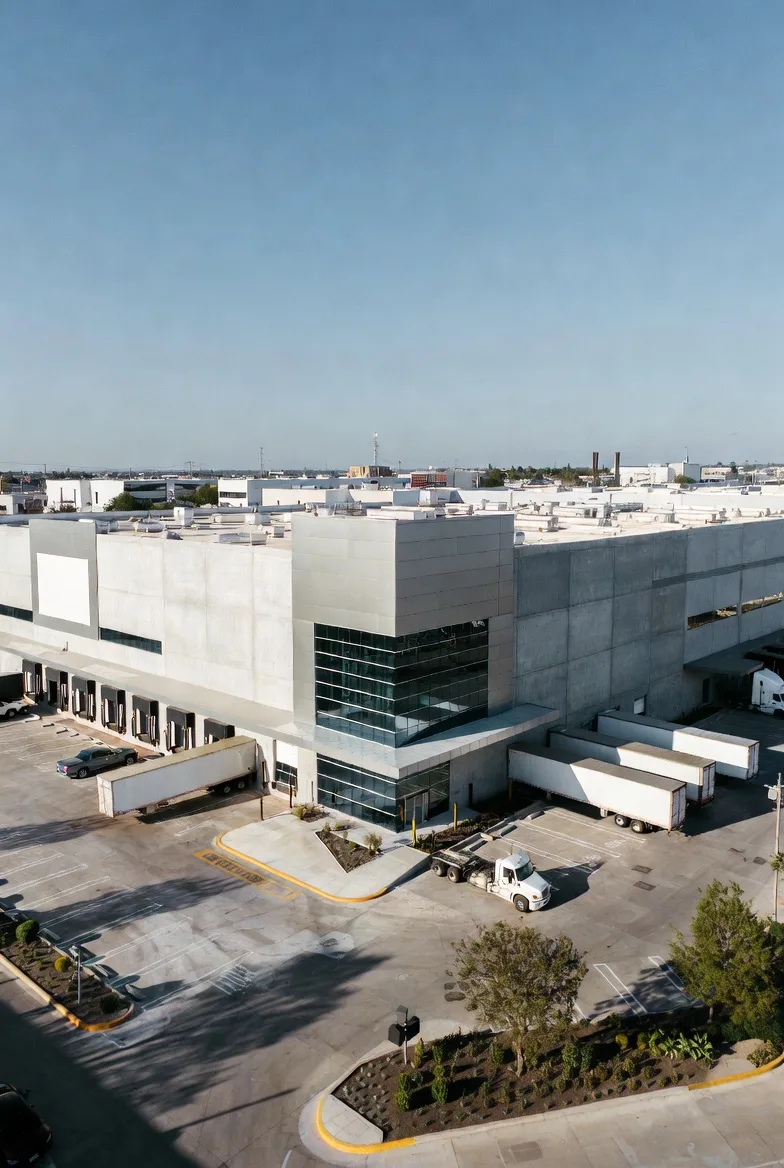
The San Jerónimo hub covers 60.32 ha next to the Santa Teresa–San Jerónimo border crossing and offers up to 20 MW. As of October 2026 it is still in pre-investment, with no companies or investment announced.
Bajío Ventures · October 2026 · The welfare hubs, one by one
San Jerónimo is the only one of Mexico’s welfare development hubs (Polos de Desarrollo Económico para el Bienestar, PODECOBI) that sits right on the US border. It is at the Santa Teresa–San Jerónimo crossing, facing New Mexico, in the municipality of Juárez. It is also one of the smallest: 60.32 ha. In exchange, it offers up to 20 MW, one of the highest power densities per hectare in the programme. The Official Gazette (DOF) declared it on 30 June 2025, and the agreement with the state was signed on 4 December 2025. In August 2026 it was still in pre-investment. On 3 September 2026 local press still described it as a project that must move from planning to execution.
The fact sheet
| Field | Data |
|---|---|
| Official name | Polo de Desarrollo Económico para el Bienestar San Jerónimo |
| State and municipality | Chihuahua / Juárez |
| Area | 60.32 ha |
| Declaration (DOF) | 30 June 2025 (signed 19 June 2025) |
| SE–state agreement | 4 December 2025 |
| Target sectors | Logistics, industrial innovation centre, automotive, electromobility, medical devices, tech services |
| Developer | Not announced |
| Announced investment | None |
| Status | Pre-investment/Preparation (Proyectos México, revised 4 August 2026) |
Connectivity
- Santa Teresa–San Jerónimo border crossing with New Mexico.
- Juárez urban area: 800 m.
- Rail: 15 km.
- Airport: 25.3 km.
- Part of the Corredor Industrial del Norte, near the Santa Teresa dry port.
- Neighbouring municipalities: Ascensión, Ahumada and Guadalupe.
- Industrial land use (PDU Sostenible 2016). Juárez holds 60% of the state’s industrial parks.
Energy and water
The declaration records gas and electricity on the plot. Proyectos México offers up to 20 MW. The El Encino–Topolobampo gas pipeline runs 25 km away, with about 1.2 million cubic feet per day estimated for the hub. Water would come from “local projects”, with no volume published.
Twenty megawatts on 60 ha is a high density for an industrial park. It is enough for several medical-device or electronics plants, and for a mid-size auto-parts plant, which typically needs several megawatts. Electromobility is different: battery assembly or vehicle testing can absorb a large share of that capacity in a single tenant. Water is the weak point. In the Chihuahua desert, “local projects” is not a number. An investor should ask for the volume and source before committing to a building.
What to watch
- No developer, no tenants. No companies, amounts or jobs announced as of October 2026.
- Late agreement. The agreement was signed on 4 December 2025, almost six months after the declaration. Immediate expensing covers only assets acquired from that date until 30 September 2030.
- Water without a figure. The official sheet gives no volume or specific source.
- Exposure to the USMCA review. The hub’s appeal is the border. Its pace will depend on trade rules with the United States after the 1 July 2026 review.
Our view
The state adds its own incentives to the federal ones: up to 100% of payroll tax for up to 5 years, a 55% discount on CENALTEC training and up to 95% off state industrial land. The federal incentive is the same in all 15 hubs: 100% immediate deduction of new fixed assets plus an extra 25% on the increase in training or innovation spending (details in the pillar piece). There is no income-tax exemption. Juárez already has a mature industrial market. The hub competes with private parks that already operate, and its real advantage is cheap state land next to the crossing.
For an energy developer, 20 MW of grid supply, gas 25 km away and strong solar resource make an attractive mix. Self-supply projects under 0.7 MW need no generation permit. Storage can cover peaks from electromobility loads without waiting for CFE reinforcements. But there is no anchor customer. Until the state names a developer, this is a hub to track, not to negotiate.
Series: The 15 welfare hubs as of October 2026 · The Michoacán hub and Guanajuato: one corridor
Sources: DOF, San Jerónimo hub declaration, Jun-2025 · DOF, PODECOBI tax-incentive decree, May-2025 · Proyectos México, PODECOBI San Jerónimo, Aug-2026 · SE, coordination agreement with Chihuahua, Dec-2025 · SE, PODECOBI San Jerónimo one-pager · El Diario/tiempo.com.mx, San Jerónimo hub, Sep-2026
Bajío Ventures — a Mexican energy-infrastructure investment group based in Guanajuato.
This article is also available in Spanish. Read in Spanish