Thesis
Why the Bajío, and why energy
Industrial demand is not the problem. Nearshoring investment grew 39% in 2025, and northern Mexico's industrial vacancy still multiplied sevenfold. What broke was the infrastructure underneath — and that is where we work.
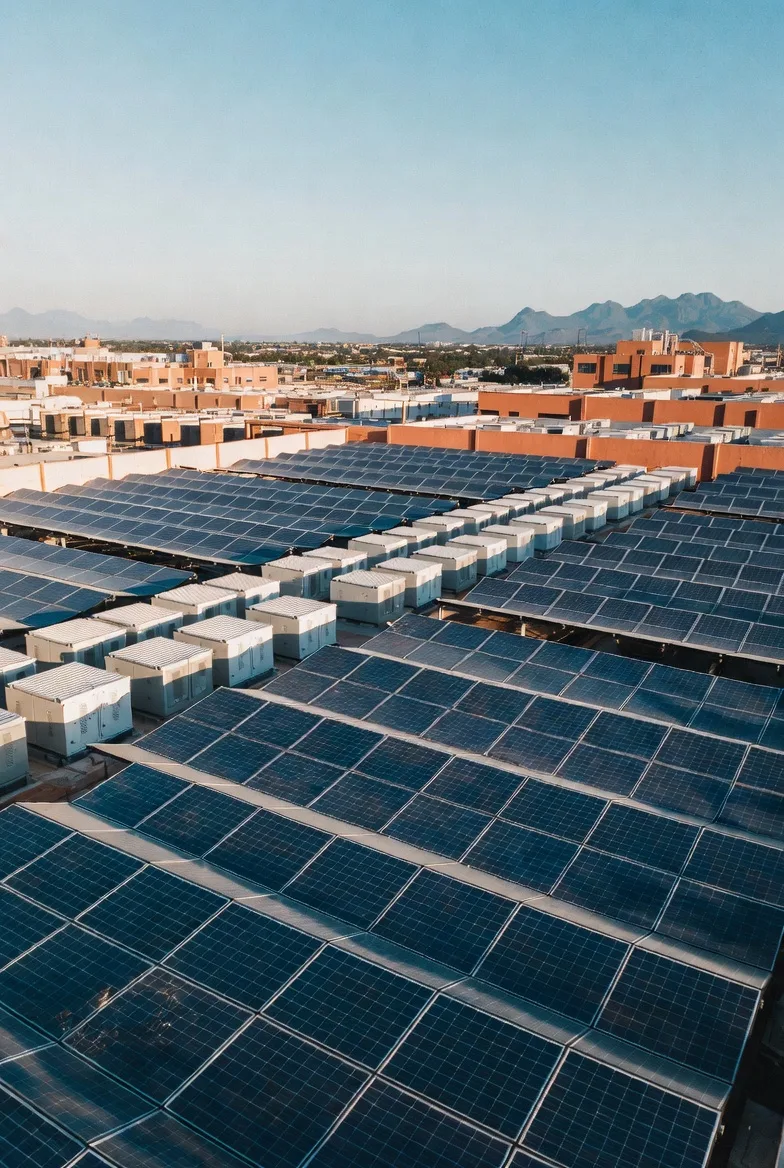
Origination and structuring of USD 5–50M infrastructure projects across the Bajío.
Let's discuss your projectIn 2023, industrial vacancy in northern Mexico was 1%. By 2025 it had reached 7% — seven times higher in two years, according to Prodensa. Over the same period, foreign direct investment tied to nearshoring reached USD 21.25 billion, up 39% year on year.
Read together, those two numbers say something uncomfortable for anyone investing in industrial buildings: demand did not fall. What ran out was the ground’s capacity to absorb it. And that capacity — water, power, gas — is infrastructure, not real estate.
That is where our thesis starts.
The north ran into its own infrastructure
Three things changed where a plant lands:
Power. 91% of companies located in industrial parks report difficulty securing electricity supply, and 40% have problems with natural gas, according to Industry & Energy Magazine. Land location and price stopped being the deciding criterion; firm, redundant capacity is.
Water. Six border states — Baja California, Sonora, Chihuahua, Coahuila, Nuevo León and Tamaulipas — face recurring, structural scarcity. For a water-intensive industry that is no longer a climate risk: it is an exclusion criterion.
A new kind of electrical load. Advanced manufacturing, electronics and computing demand power profiles a conventional park cannot sustain on a standard service connection. Whoever arrives with that load asks about megawatts first, not square metres.
Why the Bajío
The Bajío — Guanajuato, Querétaro, Jalisco, Aguascalientes and San Luis Potosí — holds roughly 14.4 million m² of industrial inventory growing at close to 4% a year, and accounted for about 30% of Mexico’s new industrial construction starts in early 2026. Our territorial layer covers 162 industrial parks across those five states, with demand profile, installed capacity and observed supply constraints.
The region is not winning because it is cheaper. It is winning because it is less exposed to the two constraints now slowing the north — and because capital has already moved: investors are prioritising parks with integrated energy capacity over parks with available land.
That does not make it immune. It means the Bajío has a window — not an entitlement — to solve its energy before hitting the same ceiling.
Why energy, and not something else
We work five sectors: energy, water, agribusiness, logistics and technology. Energy comes first for a structural reason, not a preference.
It is the constraint that binds all the others. A water treatment plant is an electrical load. An agribusiness cold chain is an electrical load. An automated logistics centre and a computing site are, above all, electrical loads. The sector with the hardest constraint is also the one that unlocks the other four.
And it is the sector where the gap between what is needed and what arrives has a date attached.
What changed in the rules
The Electricity Sector Law, published on 18 March 2025, replaced the isolated-supply regime with self-consumption (autoconsumo). Its Article 30 authorises a simplified permitting procedure for interconnected self-consumption plants of up to 20 MW; above that capacity there is no cap, only the ordinary process.
In practice, the path for a plant to build its own generation exists and has measurable timelines. Fast-track interconnection impact studies (0.5 to 10 MW) have run at roughly 40 business days and around MXN 650,000; full studies at about 75 business days and roughly MXN 1.5 million. On top of that sits the energy-sector Social Impact Manifestation (MISSE), whose implementing rules remained unpublished, so the previous framework — about 90 business days — has been applied in practice.
The operational conclusion: the bottleneck is no longer whether it is allowed, but who structures it and who finances it.
What the State will do, and what it will not
CFE’s plan to 2030 contemplates MXN 651 billion across generation, transmission and distribution: 18,597 MW of new capacity across 52 projects (MXN 467.3 billion), 82% of it renewable; 7,545 kilometres of transmission lines (roughly MXN 132 billion); and close to MXN 52 billion in distribution, with 97 new substations and 95 expanded. CFE’s share of national generation would rise from 43% to 53% by 2030.
Two readings matter for any concrete project:
- More than half of that investment is planned off-balance-sheet, mainly through mixed mechanisms for renewable plants. There is explicit room for private capital.
- The plan is national and its horizon is 2030. A plant that needs firm capacity in 2027 cannot wait for a substation scheduled for 2029.
That distance — between the date the grid arrives and the date the plant needs power — is exactly where the financeable project lives.
Where we come in
We originate and structure USD 5–50M infrastructure projects and match them with the right capital partner. Every project passes a 100-point quantitative framework before it reaches an investor. Our target IRRs by sector: energy 12–18%, water 10–15%, agribusiness 15–22%, logistics 12–16% and technology 18–25%.
What we are not: developers, permit holders, or technology vendors. Our job is to turn an operating requirement — “this plant needs 8 firm MW in 18 months” — into a project a capital partner can underwrite, with a contract, a counterparty, allocated risk and a defined return.
If you run a plant in the Bajío
Three data points decide whether there is a project, and you already hold all three:
- Consumption profile. Contracted demand, load curve and average bill for the last twelve months.
- Available space. Roof, adjacent land or a plot inside the park — and who holds the title.
- The date. When you need the capacity. That date determines the technology, the structure, and whether the project is financeable at all.
That is enough for a serious first conversation. Without it, any energy discussion stays generic.
Sources: Inmobiliare — nearshoring, energy and infrastructure 2026 · La Crónica — CFE investment plan to 2030 · Acclaim Energy — CNE self-consumption permit requirements
Origination and structuring of USD 5–50M infrastructure projects across the Bajío.
Let's discuss your projectThis article is also available in Spanish. Read in Spanish