Thesis
Permitting is no longer the problem
Halfway through Mexico's 2024–2030 National Energy Plan, the binding constraint has moved: from the permit desk to the grid. For industry in the Bajío, that changes which decision has to be made, and when.
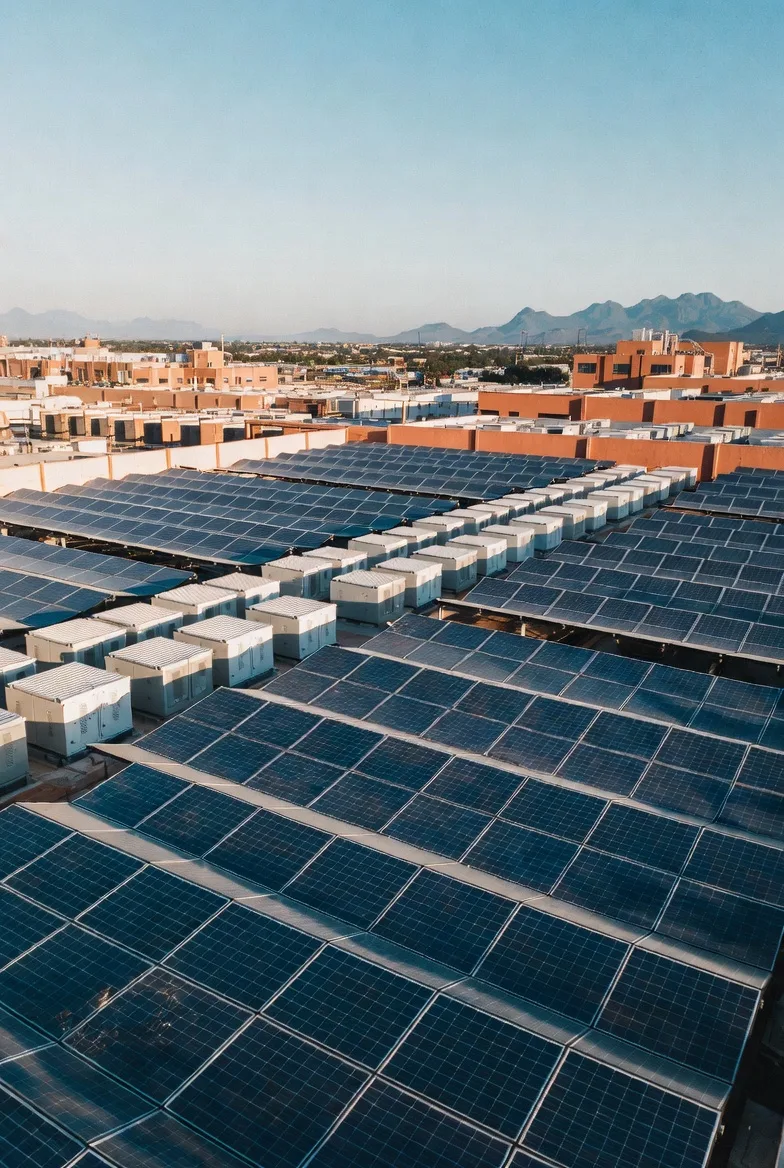
Behind-the-meter generation and storage for industrial plants across the Bajío.
Let's discuss your projectTwenty-two of the seventy-two months of Mexico’s 2024–2030 National Energy Plan have now passed. That is long enough to stop debating intentions and start reading results.
The result fits in one sentence: the plan is delivering what it was designed to deliver, and failing at almost everything that depends on physical product. Public control of the generation mix is established, and private investment is flowing again through a channel the State administers. Barrels, cubic feet and percentage points of clean generation, by contrast, have not moved.
Start with the denominator
Before quoting any completion percentage, it is worth asking what it is measured against. Three different official targets for additional capacity are currently in circulation:
- 22,574 MW — National Energy Plan, November 2024.
- 28,004 MW for 2025–2030 — Electricity Sector Development Plan (PLADESE), October 2025.
- 32,000 MW by the end of the term — Second Government Report, September 2026.
The target has been revised upward twice in twenty months. This is not a bookkeeping detail: the same progress can be presented as 65% or as 46% depending on which document is used as the reference. We use PLADESE, the binding instrument on which permit eligibility depends. Against that denominator, just over half of the capacity required by 2030 has an identified owner — and none of the private share is under construction.
What worked
The first round of Mixed Development Schemes, resolved in June 2026, awarded more than 7,400 MW across 37 projects, above the 6,500 MW required, with over two hundred proposals submitted. It is the largest renewable award resolved in a single act since the 2015–2017 auctions. Investor appetite is not the problem.
CFE did not stand still either: six combined-cycle plants completed in two years and just over 3,700 MW in testing or construction for 2026. In Guanajuato, Salamanca II — 495 MW — remains in tender.
And the regulatory scaffolding, late as it was, now exists: three of the four regulations in October 2025, and during 2026 the storage rules, the cogeneration rules, the 0.7 MW self-supply threshold and the guidelines for migrating legacy permits.
What did not
In the same round that was celebrated, forty-six lots were declared void, and grid saturation appears among the stated causes. The award also came out overwhelmingly solar: wind fell far short of what was required and concentrated solar received nothing. The mix being contracted is not the mix that was planned.
The Occidente region obtained roughly 310 of the 1,540 MW it needed. It was the worst-served region in the country.
The second call for proposals — the one requiring 30% associated storage — has been rescheduled four times, with the award pushed to 9 November 2026.
Clean generation remains close to 23% against a 38% target for 2030 — fifteen points in four years, after having missed the statutory 35% target for 2024.
The number that orders everything else
Grid saturation stopped being a developer’s talking point and became a cause of action written by the authority itself. That is what changed in this period.
The transmission programme is advancing — thirty works completed, forty-seven in development covering 3,473 kilometres, seventy-seven still to be tendered — but transmission and distribution budget lines were cut in 2026, and the system’s operating reserve margin sits around 9%. Six zones of the country show pressure documented in official planning. Two of them are in our corridor: Querétaro–San Juan del Río, where the Las Mesas link operates close to its limit, and Guadalajara, with transformation above ninety percent and reinforcements scheduled through mid-2027.
At the same time, CENACE publishes no interconnection queue, no curtailed energy and no available capacity by substation. Anyone claiming to know how many megawatts are free at a given node either paid CFE for a study or has no source. Planning is binding; verification is not.
And the gas nobody is counting
The plan adds thirteen combined-cycle plants on top of a mix where gas supplies close to two-thirds of generation. That gas is overwhelmingly imported by pipeline from Texas, concentrated in a handful of border points, and the national transport system has no strategic storage of its own: days of cover against an official target of ten. It is the system’s largest single exposure, and the one least present in public debate.
What this means for a plant in the Bajío
Three things, in order of urgency:
- Some clocks are already running. The window to migrate legacy permits closes on 16 October, and the new wheeling methodology takes effect on 19 October 2026, with a tariff exception through 2028 only for those who have already filed. Migration eliminates the flat wheeling charge and the energy bank. Anyone holding legacy capacity is being repriced right now, whether they know it or not.
- No announced federal decision resolves Bajío supply within the planning horizon of an industrial building. The region was the worst served by the only round that closed, and its main state-level project is still in tender.
- The only thing under the user’s control sits behind the meter. On-site generation and storage, under the correct regime — the April 2026 rules draw a precise line between what applies to a load centre and what does not — and with the consumption profile measured before, not after, committing to equipment.
One request
Mexico’s energy sector lost data quality in exactly the period when it needed it most. We publicly ask for three dashboards: interconnection queue by node, curtailed energy by region, and available capacity by substation. They cost no infrastructure. Without them, every company investing in line with binding planning pays to discover, one by one, information the system already holds.
Bajío Ventures is a Mexican energy infrastructure investment group based in Guanajuato. It operates on three fronts: capital for on-site generation and storage projects, a data platform covering the region’s industrial base, and a German industrial channel for supply-chain and demand localisation. It maintains its own advisory presence in Berlin.
This piece summarises the institutional position paper of the same title, available on request. It draws on public sources as of 14 September 2026. Figures on which sources disagree are presented in their conservative formulation and without a date.
Behind-the-meter generation and storage for industrial plants across the Bajío.
Let's discuss your projectThis article is also available in Spanish. Read in Spanish