Infrastructure
Five Western brands, five Chinese ones: who builds a plant's electrical room
The switchgear, breakers, transformers and UPS in a Bajío plant almost always come from five Western brands. Five Chinese makers now build the same things. What decides which one gets into the project.
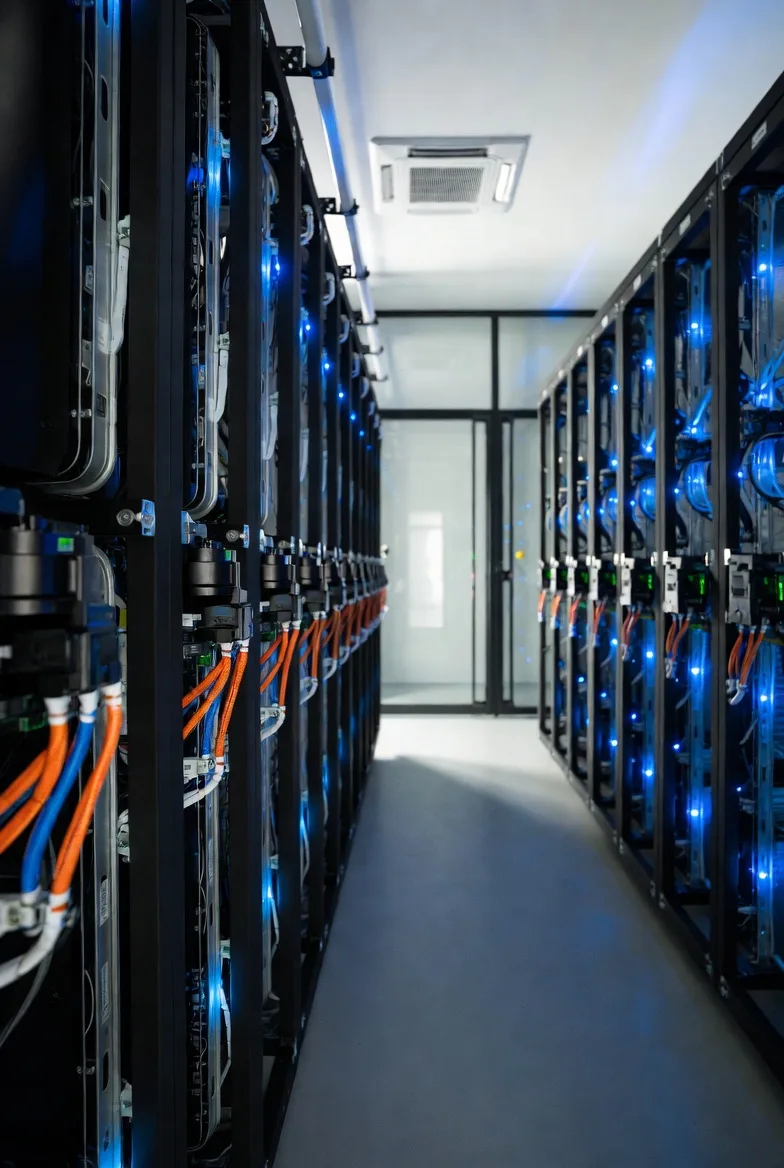
On-site generation, storage and grid-connection infrastructure for industrial plants in the Bajío.
Let's discuss your projectBajío Ventures · March 2026
In last week’s note we separated commercial and industrial (C&I) solar from the residential and utility-scale markets. This time the subject is the electrical room: everything between the CFE service entrance and the machine. In a C&I project a large share of the non-panel budget goes there, and the bill of materials is almost always filled by the same five brands.
What’s new is a second list, a Chinese one. It makes the same categories at a different price and with a different service record.
What “C&I electrical equipment” covers
| Category | What it is in the plant |
|---|---|
| Medium voltage | 13.8–34.5 kV switchgear and panels, disconnectors, protection |
| Transformers | Distribution and plant-substation units |
| Low voltage | Distribution boards, breakers (MCB, MCCB, air circuit breakers), contactors |
| Motor control | Starters, variable-frequency drives, MCCs |
| Critical power | UPS, transfer switches, power quality |
| Management | Metering, monitoring, energy software |
The usual five
- Schneider Electric (France). The world leader in low voltage. In Mexico it sells mainly under the Square D and Merlin Gerin brands, along with APC UPS units and its management platform. It manufactures in Querétaro.
- ABB (Switzerland). Low and medium voltage, drives, motors and automation. It carries a lot of weight in heavy industry. It has a plant in San Luis Potosí.
- Siemens (Germany). Its Smart Infrastructure division covers medium and low voltage and buildings, and its automation division runs much of the factory floor. Siemens Energy, the separate company, has manufactured in Guanajuato since 1981.
- Eaton (Ireland, with US roots). Switchgear, breakers and UPS. It is strong in North America and in data centres, and it is the reference when the plant exports and headquarters requires UL-listed equipment.
- Legrand (France). Final distribution, cable management, and building and data-centre infrastructure.
Close behind are Mitsubishi Electric, GE Vernova and Hitachi Energy. The last two matter more in high voltage and on CFE’s grid than in a plant’s electrical room.
The Chinese five
- CHINT (正泰, Zhejiang). The closest counterpart to Schneider: high-volume low-voltage breakers, contactors and panels, plus medium voltage and, through Astronergy, solar modules. It is the Chinese brand with the largest presence in Mexico’s distribution channel.
- Delixi Electric (德力西). Mass-market low voltage. It has been a 50/50 joint venture with Schneider Electric since 2007, so part of Schneider’s “Chinese competition” belongs to Schneider.
- Changshu Switchgear / CNS (常熟开关). China’s high end in power and air circuit breakers. At home it competes head-on with ABB and Siemens.
- TBEA (特变电工, Xinjiang). Medium- and high-voltage transformers, cable and inverters. It is the closest counterpart to the industrial side of Siemens Energy or Hitachi Energy.
- Liangxin (良信, Shanghai). Premium low voltage, focused on data centres, telecoms and new energy.
A few others are big enough to mention. Huawei Digital Power is now a serious player in inverters, UPS and data-centre power. NARI and XJ Electric dominate protection and control, but they sell mainly to China’s grid, not to plants.
Equivalents by category
| Category | Western reference | Chinese counterpart |
|---|---|---|
| Low-voltage breakers and panels | Schneider, ABB, Eaton | CHINT, Delixi, Liangxin |
| Power breakers (air circuit breakers) | Schneider, ABB, Siemens | CNS, CHINT |
| Medium voltage | Schneider, ABB, Siemens | CHINT, TBEA |
| Transformers | Siemens Energy, ABB/Hitachi Energy, Prolec | TBEA, CHINT |
| Drives and motor control | ABB, Siemens, Schneider | Inovance, CHINT |
| UPS and critical power | Eaton, Schneider (APC), Vertiv | Huawei, Kehua |
| PV inverters and storage | SMA, Fronius | Huawei, Sungrow |
What decides the purchase in Mexico
The list-price gap between the two columns is often large, but it rarely decides the purchase. These factors do:
- The specification. Many Bajío plants are subsidiaries of a German, US or Japanese group with an approved-vendor list. If the brand is not on it, it doesn’t get in at any price.
- Certification. Equipment has to meet the applicable NOM. If the plant exports to the US or headquarters requires it, it also has to be UL-listed. Anything delivered to CFE goes through LAPEM testing. The large Chinese brands already hold international certifications, but coverage in Mexico has to be checked product by product.
- Service. An air circuit breaker with no spare parts or technician in the region is a plant shutdown waiting for a date. Here the Western five still have a network the Chinese are only starting to build.
- Lead time. For transformers and medium voltage, delivery time now matters more than price. This is where Chinese suppliers win projects, because they deliver sooner.
- Tariffs. Since 1 January 2026 a decree has been in force that raises tariffs by up to 50% on about 1,400 tariff lines imported from countries without a trade agreement with Mexico, China included. Coverage depends on each item’s tariff line, so check it before quoting.
The dependence is already there. In 2024 Mexico imported USD 6.73 billion of transformers and static converters (HS 8504), and 48% came from China. Under the same heading it exported USD 7.43 billion, 95% of it to the United States. The Bajío assembles for North America with components that arrive from Asia.
The takeaway
- In C&I, the buyer picks the brand, not the developer. A project that proposes equipment off the corporate list loses time in detailed engineering. Ask for the approved-vendor list on day one.
- Chinese suppliers compete on lead time before price. Where delivery is the bottleneck (transformers, medium voltage, storage), the second column already decides projects. In low voltage, the service network still wins.
- Tariffs change the math, not the direction. A 35% or 50% duty makes the Chinese option more expensive, but it doesn’t replace the manufacturing capacity Mexico lacks. The investment opportunity is in what could be made here for both columns.
Sources: Expansión, Mexico publishes decree adjusting tariffs on countries without a trade agreement, Dec 2025 · INCOMEX, the new tariff scheme enters into force, Jan 2026 · Schneider Electric, Delixi Electric further expands its activities in China, Jan 2019 · CNC Electric, analysis of the global and Chinese low-voltage market · Data México, Ministry of Economy
Bajío Ventures — a Mexican energy-infrastructure investment group based in Guanajuato: capital, a data platform on the region’s industrial base, and a German industrial channel, with its own advisory presence in Berlin.
On-site generation, storage and grid-connection infrastructure for industrial plants in the Bajío.
Let's discuss your projectThis article is also available in Spanish. Read in Spanish