Market
The Nezahualcóyotl hub, State of Mexico: urban land next to the airport, no developer
68.37 ha on the Mexico City boundary, with gas, power and rail inside the polygon and projected demand of 5 to 7.7 MW. Fourteen months after its declaration it is still in pre-investment, with no companies and no official investment figure.
Bajío Ventures · October 2026 · The welfare hubs, one by one
Nezahualcóyotl is the most urban site on the list. The welfare development hub (Polo de Desarrollo Económico para el Bienestar, PODECOBI) covers 68.37 ha on the Mexico City boundary, near Mexico City International Airport (AICM), with access to Circuito Interior. The declaration says the site already has gas, electricity and rail inside the polygon. It is serviced urban land in the country’s largest consumer market. Even so, as of October 2026 it has no developer, no companies and no official investment figure.
The fact sheet
| Field | Data |
|---|---|
| Official name | Polo de Desarrollo Económico para el Bienestar Nezahualcóyotl |
| State and municipality | State of Mexico / Nezahualcóyotl |
| Area | 68.37 ha in three lots (3-B of 21.05 ha, 3-C of 29.21 ha and one of 15.55 ha) |
| Declaration (DOF) | 7 August 2025 (signed 28 July 2025) |
| SE–state agreement | 1 December 2025 |
| Target sectors | Logistics, digital economy, tech services, electronics, light industry, pharma, medical devices |
| Developer | Not appointed |
| Announced investment | “Initial investment close to MXN 800 million” and more than 4,500 jobs (26 June 2025 announcement); Proyectos México: N.D. |
| Status | Pre-investment / preparation (Proyectos México, 5 August 2026) |
Land use is industrial (municipal letter PM/NEZA/175/2025). The agreement with the Ministry of Economy was signed almost four months after the declaration. That delay matters: the incentives in the 22 May 2025 decree apply to assets acquired from the agreement date. The decree grants a 100% immediate deduction for new fixed assets and an extra 25% on the increase in training or innovation spending; details are in the pillar piece.
Connectivity
- On the Mexico City boundary; immediate access to Circuito Interior and primary roads.
- Close to AICM (the declaration gives no distance in kilometres).
- Rail network inside the polygon.
- Talent: 15 higher-education institutions in Nezahualcóyotl, 32 including Atenco, Chimalhuacán, Ecatepec and La Paz; 17 upper-secondary schools.
Energy and water
SENER’s opinion in the declaration gives these figures:
- Demand of 5 to 7.7 MW between 2027 and 2030.
- Supply through the distribution grid; the nearest distribution substation is 1.8 km away.
- At high voltage, connection at the Nezahualcóyotl substation at 85 kV through a line of about 0.2 km. For more capacity, a tap on the Aurora–Chapingo line.
- The nearest CENAGAS pipeline, the “Tierra Blanca–Venta de Carpio” segment, is 50 km away.
The declaration states there is gas inside the site and also puts the trunk line 50 km away. Both can be true if site gas comes from a local distribution network; no source gives the detail.
The target sectors match the available load. Logistics, digital services and medical devices use little power per hectare. A large data centre or a big electronics plant would not fit in 7.7 MW without reinforcement.
There is no water volume. SEMARNAT requires the project to “guarantee water recharge, waste management, and avoid impacts on ecosystem services of the adjacent natural protected area”.
What is missing
- Developer. No tender or direct award has been published.
- Companies. None announced in fourteen months.
- Investment figure. The MXN 800 million of June 2025 does not appear on the official sheet, which shows N.D.
- Environmental condition. The adjacent protected area constrains the design and the drainage and recharge works.
Our view
Nezahualcóyotl does not compete with Celaya or Altamira for heavy manufacturing. It competes for last-mile logistics and services near the airport, where industrially zoned land is scarce. That makes the missing developer surprising: the product looks easy to sell. The likely explanation lies in land tenure, the structure of the state vehicle or the cost of urbanizing next to a protected area. No source clarifies it.
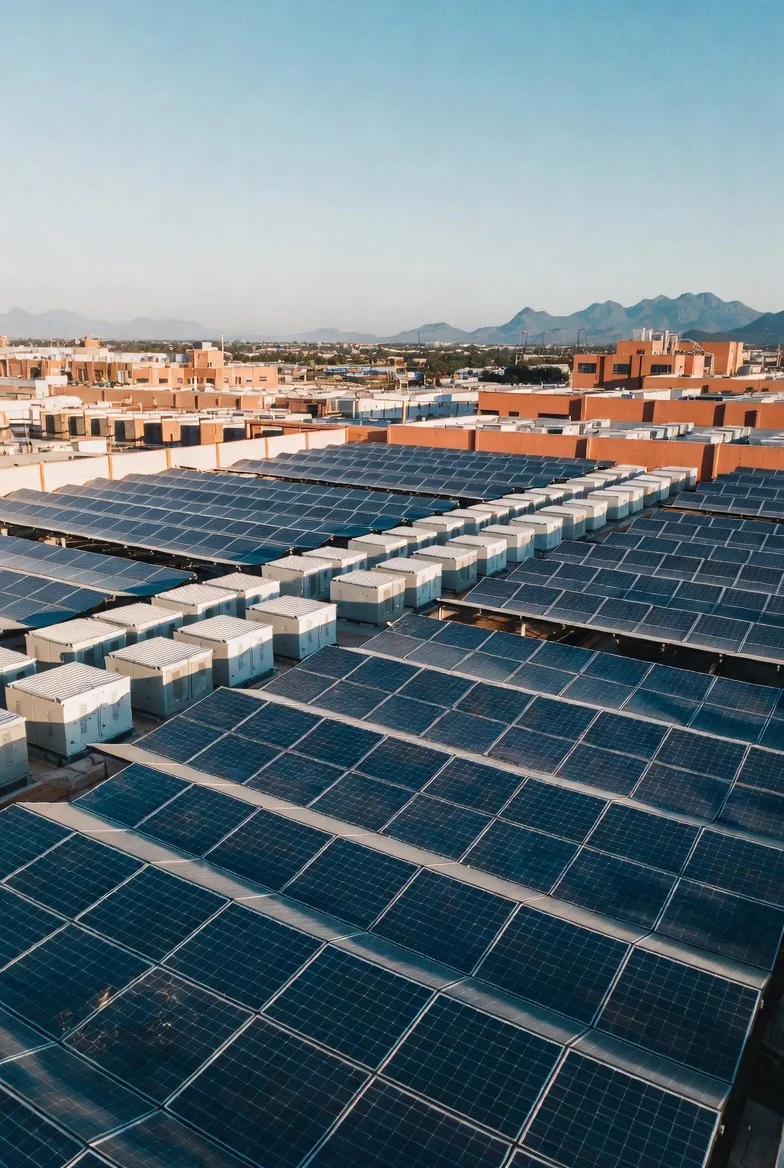
On energy, the grid is close and at a useful voltage: 85 kV at 0.2 km. That makes a mixed scheme viable: grid supply, rooftop solar and storage to cover the peaks of refrigerated warehouses. Several self-supply projects under 0.7 MW per building need no generation permit. Until there is a developer, nobody can contract anything.
Series: The 15 welfare hubs as of October 2026 · The Michoacán hub and Guanajuato: one corridor
Sources: DOF, Nezahualcóyotl declaration, Aug-2025 · DOF, tax-incentive decree, May-2025 · Proyectos México, sheet 1015, Aug-2026 · SE–State of Mexico agreement, Dec-2025 · El CEO, hub in Nezahualcóyotl, Jun-2025 · PorEsto, the 15 hubs, Jun-2025 · Forbes México, investment in Neza, Aug-2025
Bajío Ventures — a Mexican energy-infrastructure investment group based in Guanajuato.
This article is also available in Spanish. Read in Spanish