Thesis
Where the Bajío lives in the United States
Texas is the first destination for migrants from all four Bajío states: it holds about 44% of their consular ID cards, double its share among Mexicans as a whole. San Luis Potosí sends two out of three there; Aguascalientes spreads across Texas, California, Illinois, Colorado and Oklahoma.
Origination and structuring of USD 5–50M infrastructure projects across the Bajío.
Let's discuss your projectBajío Ventures · March 2026
Migrants from the Bajío live in Texas first. Texas is the top U.S. state of residence for all four Bajío states — Guanajuato, San Luis Potosí, Querétaro and Aguascalientes — and holds about 44% of the consular ID cards issued to their people in 2022, double the 21% share for Mexicans as a whole.
California, the leading destination for Mexico overall, comes second at about 15%. After that the map splits state by state: Illinois for Guanajuato and Aguascalientes, Florida for Querétaro, Georgia for San Luis Potosí.
Four states, one first choice
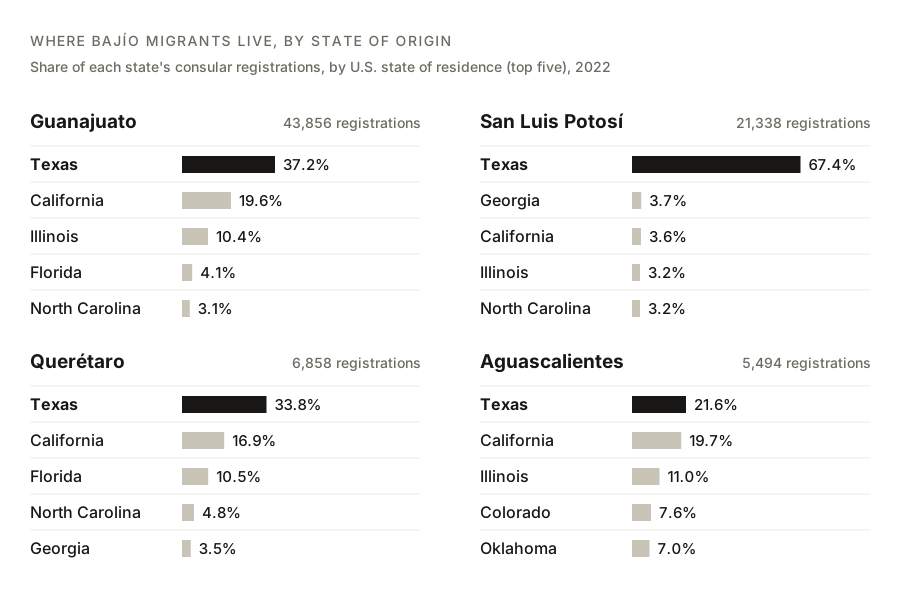
The four states differ in how hard they lean on Texas. San Luis Potosí is almost a single corridor, while Aguascalientes is split nearly evenly between Texas and California.
Guanajuato: Texas, then California and Illinois
Guanajuato is the Bajío’s largest sender by far, and 37.2% of its migrants register in Texas. California follows at 19.6% and Illinois at 10.4%, with Florida (4.1%) and North Carolina (3.1%) completing the top five.
The state accounted for 43,856 consular registrations in 2022, 7.7% of the national total and the fourth-highest of any Mexican state. Men made up 65% of them. The leading municipalities of origin were León (10.2%), Celaya (8.5%), Irapuato (6.8%), Dolores Hidalgo (4.7%) and Salamanca (4.0%).
That spread matters: the five largest municipalities add up to barely a third of the total. The other two-thirds come from the state’s remaining 41 municipalities, well beyond the industrial corridor cities.
The money confirms the scale. Guanajuato received USD 5,645 million in remittances in 2024, second in Mexico and USD 2 million behind Michoacán, equal to an estimated 7.0% of the state’s GDP.
San Luis Potosí: two-thirds in one state
San Luis Potosí has the most concentrated corridor in the region: 67.4% of its migrants register in Texas. No other state reaches 4%. Georgia takes 3.7%, California 3.6%, and Illinois and North Carolina 3.2% each.
Only three Mexican states are more tied to Texas, and all three share a border with it: Nuevo León (80.7%), Tamaulipas (77.7%) and Coahuila (70.6%). San Luis Potosí behaves like a border state without being one.
The state accounted for 21,338 registrations in 2022, 3.8% of the national total, 62% of them men. That is half Guanajuato’s volume, yet it places almost as many people in Texas: roughly 14,400 against 16,300.
Origins are split between the capital and the countryside. San Luis Potosí city leads with 18.0%, followed by Rioverde (10.5%), Matehuala (6.2%), Ciudad Valles (4.1%) and Mexquitic de Carmona (3.9%). Remittances reached USD 2,083 million in 2024, an estimated 4.9% of state GDP.
One level down: Houston or Dallas
Inside Texas, San Luis Potosí splits almost evenly between Houston and Dallas, and the municipality decides which. The Houston consular district issued 25.2% of the state’s cards in 2018 and Dallas 24.4%. The capital and its neighbours lean to Dallas; the Zona Media around Rioverde leans to Houston.
A consular district, the block of counties one Mexican consulate serves, is the closest public data gets to a county. The municipality-by-municipality detail is in San Luis Potosí in Texas: Houston or Dallas, depending on the municipality.
Querétaro: Texas, and a turn to the Southeast
Querétaro sends 33.8% of its migrants to Texas and 16.9% to California, but its third destination is Florida at 10.5%. That is more than double Florida’s 4.1% share for Mexicans as a whole.
North Carolina (4.8%) and Georgia (3.5%) follow. Together the three southeastern states take 18.8%, more than California. Illinois, third for Mexico overall, does not make Querétaro’s top five.
The flow is small and unusually male. The state accounted for 6,858 registrations in 2022, 1.2% of the national total, and 75% went to men against 60% nationally.
The capital supplies 29.4% of them and San Juan del Río 13.5%. The next three are rural and highland municipalities: Cadereyta de Montes (8.4%), Amealco de Bonfil (8.3%) and Jalpan de Serra (6.8%) in the Sierra Gorda. Remittances were USD 1,277 million in 2024, an estimated 2.9% of state GDP, the lowest dependence of the four.
Aguascalientes: the most evenly spread
Aguascalientes has no dominant destination. Texas leads with 21.6%, California is close behind at 19.7%, and Illinois takes 11.0%.
The distinctive part is the Plains and the Rockies: Colorado receives 7.6% and Oklahoma 7.0%. Oklahoma’s share is the highest of any Mexican state in the 2022 data.
The top five destinations cover only 67% of the state’s migrants, so a third live somewhere else. This is the smallest flow of the four: 5,494 registrations in 2022, 1.0% of the national total, 68% of them men.
Origins are concentrated in the capital, with 55.2%. Calvillo follows at 12.3%, then Rincón de Romos (9.6%), Pabellón de Arteaga (6.5%) and Jesús María (5.9%). Remittances were USD 958 million in 2024, an estimated 3.9% of state GDP.
The wider Bajío: California takes over to the west
The states on the Bajío’s western and southern edge point to California instead of Texas. Jalisco sends 50.6% of its migrants there and Michoacán 44.8%; Zacatecas, to the north, follows the Texas-first pattern of the core.
| State | Registrations, 2022 | First | Second | Third |
|---|---|---|---|---|
| Michoacán | 54,279 | California 44.8% | Illinois 13.8% | Texas 11.8% |
| Jalisco | 36,239 | California 50.6% | Texas 10.7% | Illinois 9.8% |
| Zacatecas | 18,306 | Texas 32.0% | California 22.8% | Illinois 10.5% |
These are whole-state figures, and only part of each state is Bajío. In Jalisco, the Altos towns closest to the Bajío do appear among the top five origins: Lagos de Moreno (4.0%), Tepatitlán de Morelos (2.7%) and Arandas (2.3%). Zacatecas also shares Aguascalientes’s lean toward Colorado (4.9%) and Oklahoma (3.4%).
How to read these numbers
Every share above comes from consular ID cards (matrículas consulares), which record both the holder’s home state in Mexico and their U.S. state of residence. They show where people are, not how many there are.
- They count cards, not residents. Mexico issued 566,547 in 2022. People with other U.S. identification have less reason to apply, so long-settled and naturalised migrants are probably under-represented.
- They stop at the state line. The 2022 breakdown by home state gives U.S. states only. The finer cut, by municipality and consular district, is from 2018 and could only be retrieved for San Luis Potosí.
- They are from 2022. That is the latest year in the 2025 yearbook, and it predates the U.S. enforcement changes of 2025.
- “Bajío” here means four whole states. Guanajuato, San Luis Potosí, Querétaro and Aguascalientes are counted in full, including areas such as the Huasteca and the Sierra Gorda that lie outside the Bajío proper.
Officials and migrant groups quote much larger totals, which typically count U.S.-born children and grandchildren too and cannot be checked against this data. Examples: about 350,000 Guanajuatenses in the Dallas area, according to the Mexican consul there, and about 600,000 Queretanos in the U.S., according to a migrant association.
The combined Bajío shares (44% Texas, 15% California) are weighted averages of the four state figures, calculated for this note.
Sources: BBVA Research, Fundación BBVA and CONAPO — Anuario de Migración y Remesas México 2025, chart 4.14 (consular registrations by state of origin, 2022), chart 8.11 and map 8.1 (remittances, 2024) · Instituto de los Mexicanos en el Exterior — Matrículas consulares expedidas a originarios de San Luis Potosí en el 2018 (Internet Archive copy, 4 March 2026) · Periódico AM — Paisanos de estas 10 ciudades de Guanajuato prefieren 5 estados para residir en Estados Unidos, 19 Apr 2023 · El Universal Querétaro — Estiman que 600 mil queretanos radican en Estados Unidos, 5 Dec 2022
Bajío Ventures — a Mexican energy-infrastructure investment group based in Guanajuato: capital, a data platform on the region’s industrial base, and a German industrial channel, with its own advisory presence in Berlin.
Origination and structuring of USD 5–50M infrastructure projects across the Bajío.
Let's discuss your projectThis article is also available in Spanish. Read in Spanish