Market
Who builds Mexico's industrial parks? What the map says about the Bajío
Querétaro ties for second place nationally in number of industrial developers and Guanajuato has 13, but only a dozen firms operate in more than four states. The map shows who builds the buildings; it does not show who can power them, which is what now decides which park fills up.
On-site generation, storage and private networks for industrial developers and parks in the Bajío.
Let's talk about power for your parkBajío Ventures · October 2026
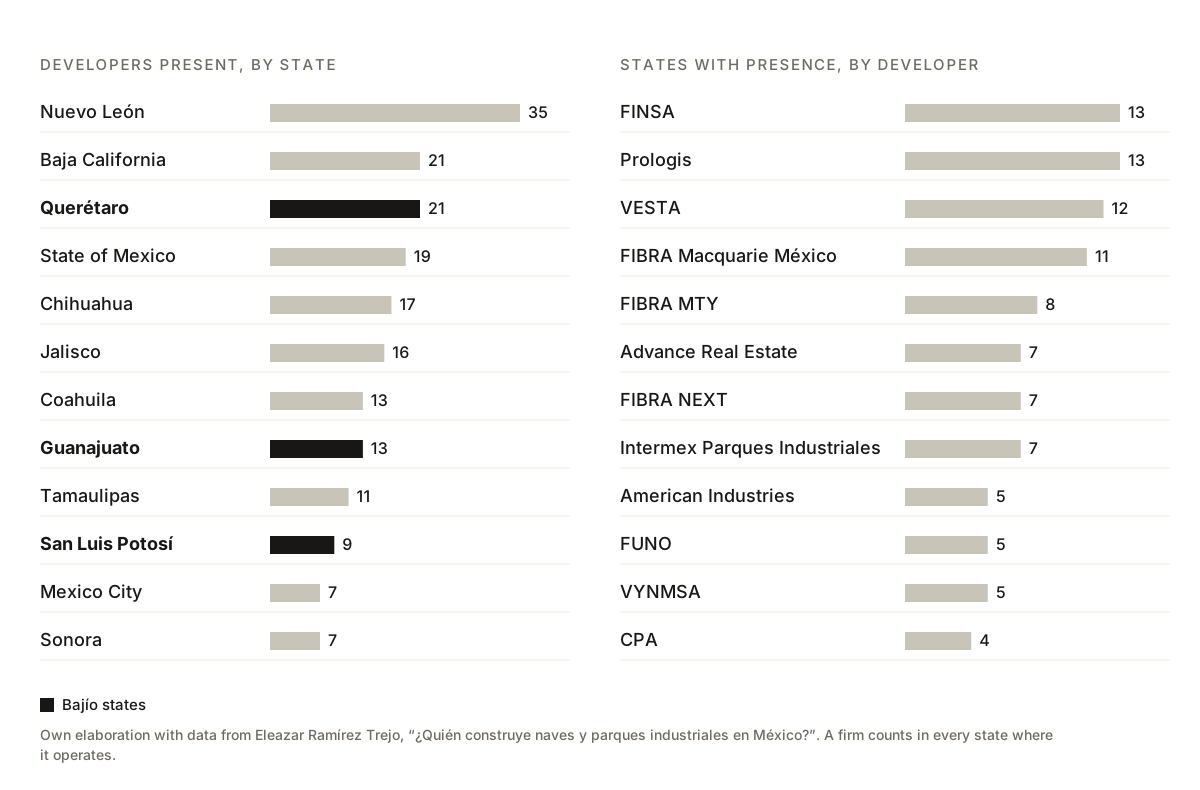
Eleazar Ramírez Trejo published a map of the firms that build industrial buildings and parks in Mexico, cut two ways: how many developers operate in each state, and in how many states each developer operates. Querétaro ties with Baja California for second place nationally, with 21 firms, behind Nuevo León (35). Guanajuato has 13 and San Luis Potosí 9. On the other side, only a dozen developers are present in four or more states, and the two most widespread reach 13 of 32.
A note on method: the counts are of firms present in each state, not of parks, square metres or investment. The same firm counts in every state where it operates, so state figures cannot be added up.
Where they build: the border, the centre and the Bajío
The list of states with the most developers repeats the geography of export Mexico: the northern border (Nuevo León, Baja California, Chihuahua, Coahuila, Tamaulipas, Sonora), the centre (State of Mexico and Mexico City) and the Bajío–West (Querétaro, Jalisco, Guanajuato, San Luis Potosí).
Within the Bajío, the ranking matches what market reports show:
- Querétaro (21) is the market with the most supply and the most competition among developers. It is also where speculative construction is highest and where vacancy rose most in 2026 (covered here).
- Guanajuato (13) has half as many developers as Querétaro along a longer industrial corridor (León–Silao–Irapuato–Salamanca–Celaya). Its new construction is mostly build-to-suit: fewer speculative buildings, less vacancy risk.
- San Luis Potosí (9) has fewer developers and demand dominated by land purchases for owner-built facilities.
- Aguascalientes is not among the twelve states with the most developers, and it is the tightest market in the country: 1.2% vacancy in August 2026. Few developers and almost nothing available are two sides of the same gap.
Who builds: few national platforms
On coverage, the market splits into two models.
| Developer | States |
|---|---|
| FINSA | 13 |
| Prologis | 13 |
| VESTA | 12 |
| FIBRA Macquarie México | 11 |
| FIBRA MTY | 8 |
| Advance Real Estate · FIBRA NEXT · Intermex Parques Industriales | 7 |
| American Industries · FUNO · VYNMSA | 5 |
| CPA | 4 |
- Public vehicles. FIBRAs and listed companies — Prologis (through FIBRA Prologis), VESTA, FIBRA Macquarie, FIBRA MTY, FUNO, FIBRA NEXT — fund themselves in the stock market and seek regional diversification.
- Private developers. FINSA, Advance, Intermex, American Industries, VYNMSA and CPA, which combine their own parks, build-to-suit and, in some cases, shelter services.
What matters is what is missing from the table: no developer reaches half the states, and outside this dozen none shows more than four. Most firms on the map are regional or local. In Guanajuato and San Luis Potosí that means smaller parks, owned by people who know the land and the municipality well, but who have no in-house energy team.
What the map does not show: megawatts
The map tells you who builds the buildings. It does not tell you who can connect them. And that is now the variable that decides which park fills up.
According to AMPIP, as reported by El Financiero on 1 October 2026:
- The 491 industrial parks in operation demand 17,786 MW of installed capacity.
- The 82 new parks planned for 2026–2030 will require an additional 2,793 MW; incremental demand in 2027 is estimated at 705 MW, against 592 MW in 2026.
- CFE’s 2027 budget falls 8.5% in real terms, with a 12.1% cut in transmission.
- Tenants already pay a premium for documented power capacity. In the words of Claudia Esteves, AMPIP’s director general: “Electrical feasibility has gone from being added value to an elimination filter.”
Developing a park takes about three years. Whatever is not solved on the grid in 2027 will show up in occupancy around 2030.
Regulation is starting to open a way out. The 2025 Electricity Sector Law regulated self-supply for installations of 0.7 MW or more, isolated or interconnected, served through private networks. The CNE is drafting rules for private networks that serve several users inside a park. Still to be defined: where the private network ends, who controls it, and under what conditions energy can be sold to third parties inside the park.
What it means for the Bajío
- National scale does not solve interconnection. A developer present in 13 states negotiates better with tenants and capital, but every load request is resolved at a specific substation and in CENACE’s queue for that zone. In energy, every park is local.
- Regional developers need an energy partner. Parks in Guanajuato and San Luis Potosí rarely have a team that can design on-site generation, storage and a private network that complies with the CNE. That is the opportunity: making power capacity part of the real estate product.
- Where developers are few, there is room to enter. Aguascalientes, at 1.2% vacancy and outside the top twelve states, is the clearest example. San Luis Potosí and the Salamanca–Celaya corridor follow the same logic on a smaller scale.
- Competition in Querétaro will be decided in MW, not m². With more vacancy and 21 developers, the building that arrives with secured load and its own backup will lease first.
For readers following this series: the thesis is the same as in why the Bajío and why energy. The industrial land is there; electricity is the bottleneck.
Sources: Eleazar Ramírez Trejo, “¿Quién construye naves y parques industriales en México?” · El Financiero, “Parques y naves industriales demandarán más electricidad durante 2027”, 1 Oct 2026 · Puerto Interior, industrial park power demand and private networks, 23 Sep 2026
Bajío Ventures — a Mexican energy-infrastructure investment group based in Guanajuato: capital, a data platform on the region’s industrial base, and a German industrial channel, with its own advisory presence in Berlin.
On-site generation, storage and private networks for industrial developers and parks in the Bajío.
Let's talk about power for your parkThis article is also available in Spanish. Read in Spanish